
How to Find Winning Products on TikTok Shop: 6 Checks
A milk frother looks convincing in a ten-second video. The foam rises, the coffee looks better, and the comments fill with questions. That gets it onto your product shortlist. It doesn't tell you whether the motor lasts, whether customers will pay your price, or whether there's anything left after shipping and creator commission.
To find winning products on TikTok Shop, check six things: repeatable content appeal, evidence of demand, a reason to choose your version, workable margins, suitable creators, and the results of a small test. Views help you discover candidates. Orders, costs and customer feedback tell you which ones deserve more inventory.
This guide focuses on researching products for TikTok Shop US. It is a selection method, not a list of supposedly guaranteed bestsellers.
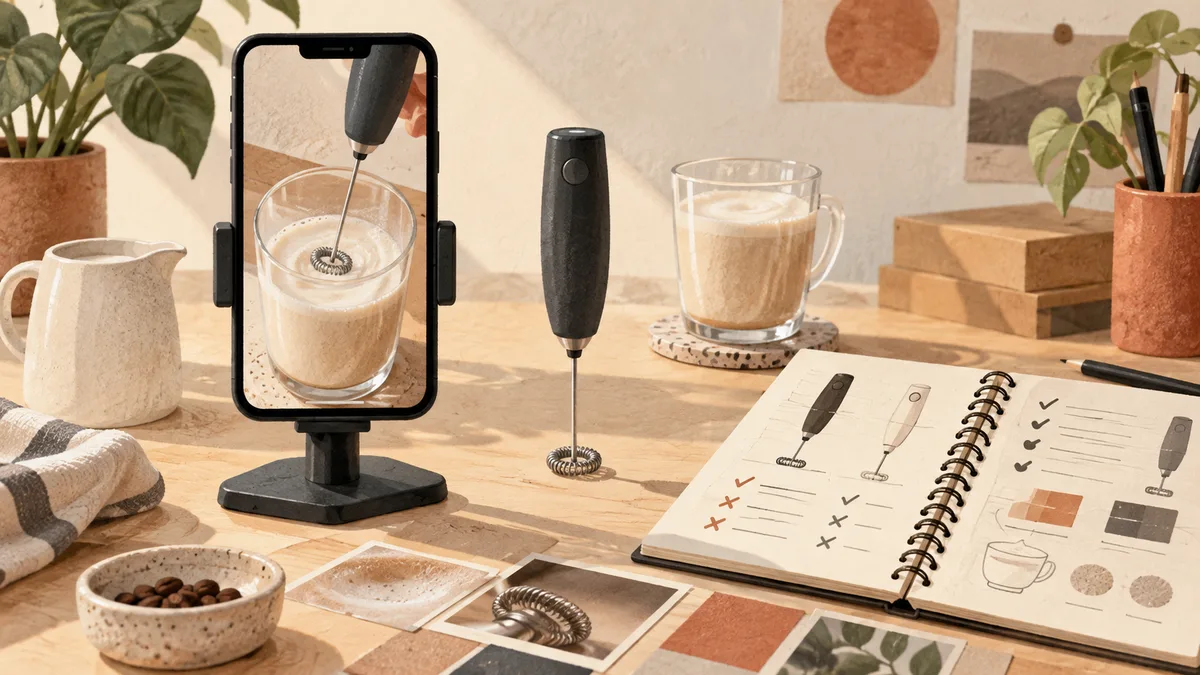
Illustration: product research connects what looks good on camera with what can work as a business.
What makes a product worth testing?
For a seller, a winning product is one you can sell repeatedly at a positive contribution margin while delivering the experience you promised. A viral clip alone doesn't meet that definition.
Look for a benefit you can show clearly: a drawer that becomes easier to organise, a spill that is easier to clean, or a kitchen task that takes less effort. Then ask a less exciting question: can you deliver that benefit reliably at a competitive price?
TikTok Shop isn't exclusively an impulse-buying channel. It also has search and Shop Tab discovery; TikTok provides separate reporting for those routes. Content-led research is a useful starting point, but it should sit alongside listing and search research. TikTok Shop's Shop Tab & Search Analytics guide explains those channels.
Where to look for TikTok Shop product ideas
Use several sources because each answers a different question.
| Source | What to look for | What it cannot establish on its own |
|---|---|---|
| TikTok search and creator videos | Demonstrations, use cases, questions and objections | Whether viewers actually bought |
| TikTok Creative Center | Ad examples, creative patterns and emerging topics | Total organic demand or a competitor's profit |
| TikTok Shop listings | Visible prices, variants, reviews and sales indicators where available | A complete view of a seller's recent sales and costs |
| Amazon listings and reviews | Alternative products, specifications and recurring complaints | TikTok Shop conversion or an automatic price ceiling |
| Your Seller Center analytics | Your own traffic, orders and channel performance once testing starts | The economics of competing sellers |
Creative Center is a useful free starting point for advertising research. TikTok describes it as a resource for creative inspiration, including high-performing ads and trends. Treat those examples as advertising evidence, rather than a complete ranking of TikTok Shop products. About TikTok Creative Center.
1. Build a shortlist from repeatable product demonstrations
Start with one category and one market. “Kitchen products for US buyers” is manageable; “anything trending worldwide” makes comparisons much harder.
Search both product names and the problems they solve. For a drawer organiser, try variations around small kitchens, cluttered utensils and adjustable storage. A useful product may appear in a room makeover rather than a direct sales pitch.
For an initial research pass, save roughly 10–20 relevant videos across several accounts. This is a practical sample, not a statistical threshold. Record the link, creator, publication date, visible engagement, demonstration and a few representative comments.
Pay particular attention to:
- The moment the benefit becomes clear. Can another creator reproduce it with an ordinary sample?
- Specific buying questions. “Will this fit a 16-inch drawer?” tells you more about purchase intent than a string of laughing emojis.
- Recent examples from different accounts. One exceptional video may reflect the creator's skill more than the product's appeal.
- Different uses of the same item. Multiple convincing demonstrations give you more to test than one copied script.
Don't assume separate creators discovered the product independently. They may be part of the same campaign. Likewise, “Where can I buy this?” is an interest signal, not proof of a supply shortage.
Compare recent videos with older ones, but account for how long each has been live. A six-month-old video has had much more time to accumulate views than one posted yesterday. The age of the biggest video alone cannot tell you whether a trend is over.
2. Check whether the shop evidence supports the interest
Take your strongest candidates into TikTok Shop and compare equivalent products. Match size, materials, accessories and pack quantity before comparing price. A cheap replacement head is not a cheaper version of the complete appliance.
For each comparable listing, record the displayed price, discounts, shipping charge where visible, variant, review count and rating. If a sales figure is available, record its exact label and the date you collected it.
A cumulative “sold” count is not last month's sales. When a tool gives an estimate, label it as an estimate. If the period or meaning of a metric isn't clear, leave the field unresolved rather than converting it into a precise demand claim.
Check several sellers. If one accounts for most of the visible sales, investigate what distinguishes it: brand recognition, bundles, pricing, content, availability or creator relationships. You usually cannot identify the cause from public listings alone.
The useful output here is a comparison sheet with uncertainties clearly marked. You don't need to pretend it covers the whole marketplace.
3. Find a product improvement you can actually deliver
Reviews can expose the gap between an attractive demonstration and everyday use. Read positive reviews as well as negative ones: they tell you which benefits must survive any redesign.
Group complaints into three buckets:
| Complaint type | Example | Next step |
|---|---|---|
| Product limitation | Frother stops working after repeated use | Test samples and discuss measurable quality requirements with suppliers |
| Expectation mismatch | Organiser is smaller than expected | Check dimensions, photos and demonstration clarity |
| Delivery or service issue | Parcel arrived late | Investigate fulfilment rather than redesigning the product |
Low ratings deserve investigation. They may reveal a fixable inconvenience, or a product with expensive failure modes. A safety complaint cannot be outweighed by strong engagement.
Compare the same type of product on Amazon to see whether the complaints recur and how competing versions address them. Amazon provides another perspective, not a rule that your TikTok Shop price must be lower. Bundles, shipping and product specifications can change the comparison.
Write your proposed advantage as something testable: “The adjustable insert fits drawers between these measured dimensions.” Avoid claims such as “better quality” until a sample or specification supports them.
4. Calculate the margin before contacting creators
A product can sell and still be a poor choice for your business. Work out what remains per order after the costs that rise with each sale.
A practical contribution calculation is:
Net product revenue − landed product cost − fulfilment and packaging − platform fees − creator commission − expected return-related costs − attributable acquisition costs.
Use the fee schedule and commission terms that apply to your account and category. Don't deduct a seller discount twice if it is already reflected in revenue. Sample costs and fixed creator fees also belong in the test budget, even if you allocate them separately from individual orders.
Here is an illustrative calculation, not a TikTok fee quote or a product recommendation:
| Per-order assumption | Amount |
|---|---|
| Product revenue after seller-funded discount | $24.00 |
| Landed product cost | −$6.00 |
| Packaging and fulfilment | −$4.50 |
| Platform fees, assumed for this example | −$1.50 |
| Creator commission, assumed for this example | −$3.60 |
| Expected return-related cost allowance | −$1.20 |
| Contribution before ads, samples and overhead | $7.20 |
That $7.20 is not net profit. Allocating another $4 per order to advertising leaves $3.20 before samples and overhead. Under these assumptions, acquisition costs of $7.20 per order would consume the entire contribution available before those additional costs.
Build a second scenario with a lower selling price or higher fulfilment cost. A product that only works at a temporary promotional price from the supplier needs more scrutiny.
5. Check whether suitable creators can sell the benefit
Research creators before placing a large inventory order. You need to know whether there is a plausible way to reach buyers, not simply whether accounts with large followings exist.
Look for creators whose recent content fits the product's use case. Consider their demonstration style, audience questions, consistency and performance across a sample of posts. A median view count is less affected by one breakout video than an average.
If you calculate engagement, state the denominator. Interactions divided by views and interactions divided by followers measure different things; don't put them in the same comparison column.
Record disclosed sponsorships or affiliate relationships when visible. A creator mentioning a brand is not sufficient evidence of a paid deal, and engagement patterns cannot prove whether followers are genuine.
For your own collaborations, use the reporting available in TikTok Shop's affiliate tools to evaluate results. TikTok's Affiliate Seller Analytics guide covers tracking creator and content performance. That access is different from estimating a competitor's results using public posts.
6. Run a small test with a clear stopping point
The research should narrow your uncertainty enough to justify a sample and a limited test. It should not persuade you to skip them.
Before ordering, write down:
- Which product benefit the sample must demonstrate.
- Which quality checks it must pass.
- Your maximum test spend, including inventory, samples, shipping and content.
- The economics that would justify a reorder.
- The problems that would make you stop, such as repeat defects or persistent negative contribution.
Then test a few genuinely different creative angles. If viewers watch but don't click, the demonstration may be entertaining without creating buying interest. If they click but don't buy, inspect the offer, listing and delivery terms. If they buy and return it, revisit the product and its promises.
Use your own analytics to make those distinctions. Public competitor data rarely exposes the complete funnel. Very small samples can mislead, so keep the decision provisional until there is enough relevant evidence.
A product research checklist you can reuse
Keep the evidence link beside each answer. An empty field is a research task, not an invitation to guess.
| Check | What to record | What should pause the decision |
|---|---|---|
| Content appeal | Several relevant demonstrations and buying questions | Interest depends on one exceptional video |
| Demand evidence | Comparable listings and clearly defined sales signals | Only views, or sales estimates with no methodology |
| Differentiation | A specific improvement supported by reviews and samples | You cannot explain why buyers would choose yours |
| Economics | Contribution under base and downside assumptions | Fees, commissions or shipping erase the margin |
| Creator fit | Relevant creators and a feasible collaboration budget | No practical route to the intended audience |
| Delivery | Sample quality, fulfilment readiness and applicable requirements | Unresolved safety, quality or supply problems |
Don't add up green ticks and treat the total as permission to buy. A serious problem in quality or economics can outweigh everything else.
Example: deciding whether to test a milk frother
Suppose your research sample shows several creators demonstrating frothers, and comments ask about cleaning and battery life. Reviews of comparable products repeatedly mention motor failures. This is a hypothetical scenario, not a finding from a live market study.
The next step is to obtain samples and investigate the failure mode. A supplier saying “stronger motor” doesn't establish better durability. If the sample performs consistently and the revised cost still leaves room for fulfilment and creator commission, a limited test may make sense.
If the better version eliminates the margin, move on. Finding that out before buying inventory is a useful research result too.
Use AI to organise the evidence, not fill the gaps
An AI research tool can help compare supported marketplace data and summarise recurring review themes. It still needs to distinguish retrieved facts from assumptions. Nolyn's data source directory shows the available sources, and its use cases offer starting tasks.
Try a bounded question rather than asking for “the next winning product”:
Research handheld milk frothers for TikTok Shop US. Compare up to five comparable listings using available data, and review a small sample of relevant TikTok posts and Amazon reviews. Summarise prices, recurring complaints, demonstration ideas and possible improvements. Include source links, observation dates and sample sizes. Label sales figures by period and definition; mark unavailable metrics as unknown. Finish with what I should validate before ordering samples. Do not infer profit without my costs.
Start a product research task in Nolyn with a category you already understand. A focused question makes the resulting report easier to check and use.
Frequently asked questions
Can I find products to sell on TikTok Shop without paid tools?
Yes. Start with TikTok search, Creative Center, marketplace listings and a spreadsheet. Tools can reduce collection and comparison work, but they cannot replace sample testing or your own cost information.
How do I know whether a TikTok product is already saturated?
Compare equivalent offers, their pricing, differentiation and recent content. Many similar listings can indicate competition, but there is no universal seller-count threshold. Look for a specific gap you can serve profitably instead of relying on a “saturated” label.
What is a good profit margin for TikTok Shop?
There is no single percentage that fits every category and acquisition model. Calculate contribution after the costs of serving and acquiring an order, then allow for overhead and risk. A margin quoted before creator commission, returns and fulfilment can be misleading.
How can I tell whether views are turning into sales?
For your own shop, examine the relevant traffic, order and conversion reporting. For competitors, public sales indicators and third-party estimates can offer clues, but normally do not establish a complete view-to-order conversion rate.
Which products are winning on TikTok Shop right now?
A defensible answer needs a market, a time period and current evidence. Use recent content and marketplace data to build a shortlist, then check your costs and samples. A fixed list of trending products cannot tell you which one will work for your business.
TikTok Shop product research
See product research in practice.
Explore a focused TikTok Shop workflow and a real milk frother research case before starting your own task.